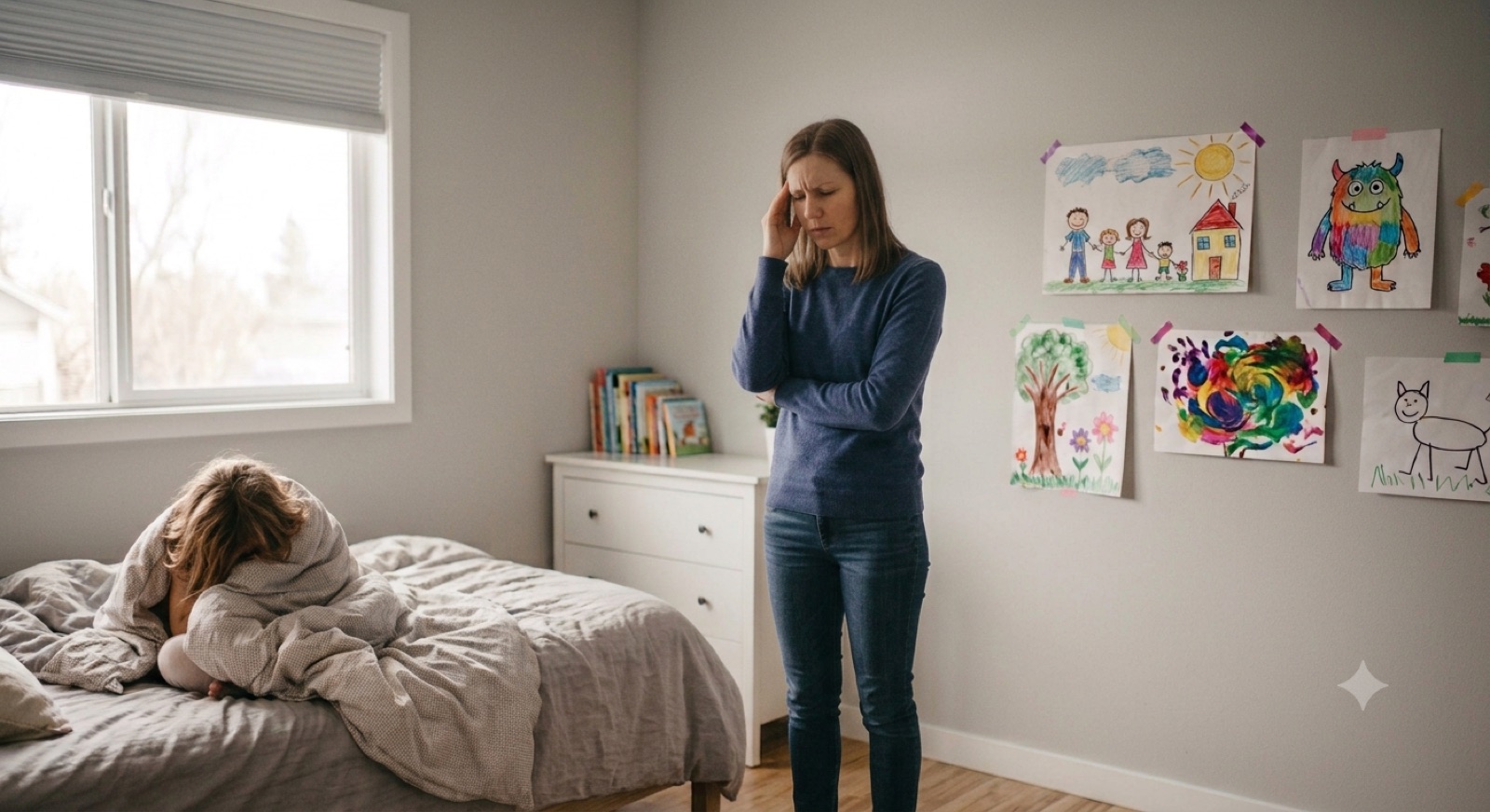
If getting your kid out the door in the morning feels almost impossible, you can probably feel your blood pressure rising just thinking about it — asking them to do the same small thing six times, problem solving socks that were fine yesterday but unbearable today, feeling the clock ticking down with every moment. Refusals at the door, meltdowns in the car, and both of you running on empty before the day has even started. This is not how you thought life would be.
We reviewed data from nearly three hundred parents using NeuraParent, describing more than a thousand real morning experiences, both the good ones and the ones that fell apart. We analyzed what happened to figure out what was actually going on underneath. And we learned two things that could change your mornings.
- Hard mornings almost never have just one cause.
- When mornings go well, it's not luck. Good mornings have a few things in common, which you can try in your own home.
It's almost never just one thing
Think about the last strategy you tried to improve mornings in your household. If it didn't work, this might be the reason: it was focused on one problem, but your kid's morning had two. Or three. (Same reason a diagnosis alone won't tell you how to parent: the label doesn't tell you which threads are yours.)
Mornings pack more expectations into a short window than almost any other part of the day. Waking, dressing, eating, brushing teeth, leaving, all with a clock counting down the minutes.
When we looked at what was going on during hard mornings, most had more than one thing happening at once. It wasn't just the rough night's sleep, or the scratchy shirt, or the looming pressure to hurry it up — it was a few of them piled on top of each other.
And the closer we looked, the clearer it was that time pressure is the great multiplier. On its own it's survivable. But coupled with anything else, a seemingly helpful "time to go in 5 minutes" can tip a morning from manageable to meltdown.
What's actually driving it when the morning routine feels impossible
Reviewing the data parents shared, we found that nearly all hard mornings fell into one of two buckets (or sometimes both): either the pressure of mornings was too much to manage, or the destination (a.k.a., school) was too hard to face. And sensory overwhelm amplified both.
When the morning itself is the hard part
Being told what to do vs. the task itself. The most common theme, in about a third of the hard mornings we analyzed, wasn't really about getting dressed or brushing teeth. It was about being directed to do those things. As a parent, you're just trying to check tasks off your list, but your kid hears it differently. For a lot of kids with autism and PDA in particular, they hear a top-down demand, and that adds pressure their nervous system isn't ready for first thing in the morning. When parents worked with their kids to build the routine, mornings went much more smoothly. "Let's decide which step to start with," is a lot easier on kids' brains than "Get dressed now."
The tank is empty to begin with. The next most common theme, from about a quarter of hard mornings, isn't actually about mornings at all. It's about yesterday's struggle bleeding into today: a poor night's sleep, that meltdown the evening before, or the slow buildup of day after day of holding it together at school — these bills come due in the morning. And when your kid's tank is already low, the routine you thought was dialed in can fall apart for what looks at first glance like no reason at all. When your kid has a tough night, it's worth expecting a tough morning and having a Plan B just in case.
Getting out is its own hurdle. For just over a fifth of hard mornings, the problem was the shift itself — the routine was done, everyone was "ready," but changing gears and transitioning out the door was the real struggle. Home is safe, comfortable, predictable. Stepping away from that can be hard, even for kids who want to be at school.
When it's not the journey, it's the destination
For about one in five hard mornings, the routine wasn't the problem at all. Getting up, getting dressed, breakfast all went fine, but the kid still wouldn't go, because their body was already braced against what they knew was ahead of them.
This one can be easy to misread. You think you have a getting-dressed problem, but that's hiding the real challenge. If your kid can move through the whole routine calmly and still falls apart getting in the car, or it's clearly worse on school days than weekends, the problem might be dread about where they're going, rather than the routine itself.
The sensory load runs underneath it all
Sensory overwhelm showed up in about one in six hard mornings. Sometimes it's the whole story — the seams, the tags, the chaos of busy mornings. But more often the sensory struggles add extra weight to mornings that were already on the brink. Sometimes you don't notice the sensory struggle at all, because your kid managed it… except it used up everything they had that morning, so the next tiny thing sets them over the edge.
Whatever separates a good morning from a hard one, it mostly isn't the child. It's the conditions around them.
What the good mornings had in common
Many of the kids in our data showed up in both the good morning and the hard morning piles. Same kid, different days. So whatever separates a good morning from a hard one, it mostly isn't the child. It's the conditions around them. Here are the 5 things that consistently came up during good mornings:
- The pressure was lower. Parents slowed down the routine, dropped an expectation, or accepted "good enough" instead of perfect. Intentionally lowering the bar happened in 38% of the good mornings versus 6% of hard ones, and it was the condition that turned up most often of all in the mornings that went well.
- Connection came first. Parents started mornings with calm presence — before asking anything of their child. Sitting down and being present together for even a minute or two can reduce morning stress for both of you. 37% versus 7%.
- The path was predictable. Parents followed a pre-decided routine, made the plan the night before, or put accommodations in place in advance. 33% versus almost none of the hard mornings.
- The kid had a say. They chose, or helped build the plan themselves. 27% versus 3%.
- There was something in it they actually wanted. Kids had their own motivation for getting going — they were going somewhere they loved or were excited to get to. 19% versus almost none.
None of these relies on reward charts, threats, or yelling. They're conditions you can set before the day starts.
The strategy parents resist most is the one that works
Reducing demands showed up more than anything else in the good mornings. It was also the advice parents pushed back on the most. When we looked at which suggestions parents told us were unhelpful, "drop it, shrink it, lower the bar" got dismissed two to three times more often than anything else.
And this makes complete sense. Because under the seemingly simple concept of lowering the demand is a series of complicated questions: Am I just giving in? Am I teaching her she can get what she wants by throwing a fit? Am I teaching him he never has to learn responsibility or independence? (If that guilt is the part sitting heaviest, we've written about that separately.)
There are no easy answers in parenting. But the short version for today: lowering the bar this morning isn't lowering your expectations for your child's future. It's trading one more failed morning for one that works. And that's the part that compounds: a kid who makes it out the door in one piece has just practiced making it out the door. A kid who ends up screaming on the floor has practiced that instead.
What should I try for my kid?
Remember it's usually more than one thing! Pick whichever sounds most like your house and start there. Each of these is really just a way of setting one of those five conditions on purpose.
If the fight is the routine itself
The pressure is the problem, so take some of it off.
- Drop one step tomorrow. Just one, and decide which the night before so you're not negotiating it at 7am.
- Let them choose the order, even if the order makes no sense to you. You can even write it down together, so they can reference the plan as they go.
- Move one task to the night before, like clothes picked or the bag packed, so there's one less thing to win in the morning.
If the problem starts at the door
The transition is the issue, not the tasks.
- Give leaving its own time block — being "ready" and being able to walk out are two different jobs.
- Shift everything ten minutes earlier, so the door isn't the moment the clock runs out.
- Build a leaving sequence together, or just let them know they can move toward the door at their own pace.
If it's worse on school days than weekends
The destination might be what needs work.
- Have the conversation at a calm moment, the day before. Not at the door, not in the car on the way in.
- Get specific about which parts of school are hardest: the noise, a particular activity, a person, the unstructured time. Specific problems are easier to solve.
- Loop in the school. This usually needs adults at both ends working together.
If mornings are worse after rough nights or big days
You're working with an empty tank.
- Treat the evening before as part of the morning. What happens at 8pm often decides what happens at 7am.
- Create a Plan B routine in advance: the stripped-back version you switch to on empty days, so you're not inventing it while running late.
- Go straight to Plan B after big days. After a trip or big event, even a good one, the bill tends to come due the next morning.
Figuring out mornings takes trial and error. Treat each change like an experiment: adjust one thing, watch for a week, keep what helped.
Mornings may never look like the ones you pictured. But they can get better.
One last thing
The most common time of day for a parent to sit down and write about the morning isn't the morning at all. It's around 9pm, once everyone's asleep — they're still up trying to figure things out. If that's you tonight: the fact that you're still turning it over isn't a sign you're failing. It's the reason your kid has someone who'll figure it out.
Frequently asked questions
Why won't my autistic child get out of bed in the morning?
Staying in bed is often less about the bed and more about what getting up starts. Every step after it is another expectation, and for a lot of autistic, PDA, and ADHD kids that whole line of demands is visible from under the covers. And it's harder when the tank is already low, so it's worth looking at the night before as much as the morning itself.
My PDA child won't get ready for school — what actually helps?
In about a third of the hard mornings we looked at, the sticking point wasn't the task, it was being told to do it. What showed up in the mornings that went well was the pressure coming off: building the routine together, dropping a step, or accepting "good enough" for today.
Is my child's morning resistance actually school refusal?
They look identical at the door but they're different problems. If the fight is the routine itself, you're likely dealing with pressure and transitions. If your child moves through the whole routine calmly and still won't leave, especially when it's worse on school days than weekends, the issue is more likely to be related to school itself. Think about bringing the school into the conversation.
Why is my autistic child so much harder in the mornings than the rest of the day?
Mornings pack more expectations into a short window than almost any other part of the day, onto a nervous system that may not be fully recharged, and against a clock. Most of the hard mornings we looked at had two or more of those going at once, which is why a single fix so rarely holds.